
THE REVOLUTIONS OF 1848
The Revolutions Begin
In 1848, a wave of revolutions swept across Europe. From France to Italy, from the German states to the Austrian Empire, people rose up demanding change. These movements shared similar goals: freedom, better working conditions, and more say in government. Many hoped for democracy, national unity, and equality.
The revolutions were inspired by earlier ideas from the Enlightenment and the French Revolution. People were frustrated with kings and emperors who refused to share power. Economic troubles also played a big role. Food shortages and job losses made life difficult for many.
However, not all revolutions succeeded. In most places, old rulers regained control within a year. Still, the Revolutions of 1848 were important because they showed that ordinary people could challenge authority and demand rights. Even though most uprisings failed, the ideas behind them continued to grow, shaping modern Europe.
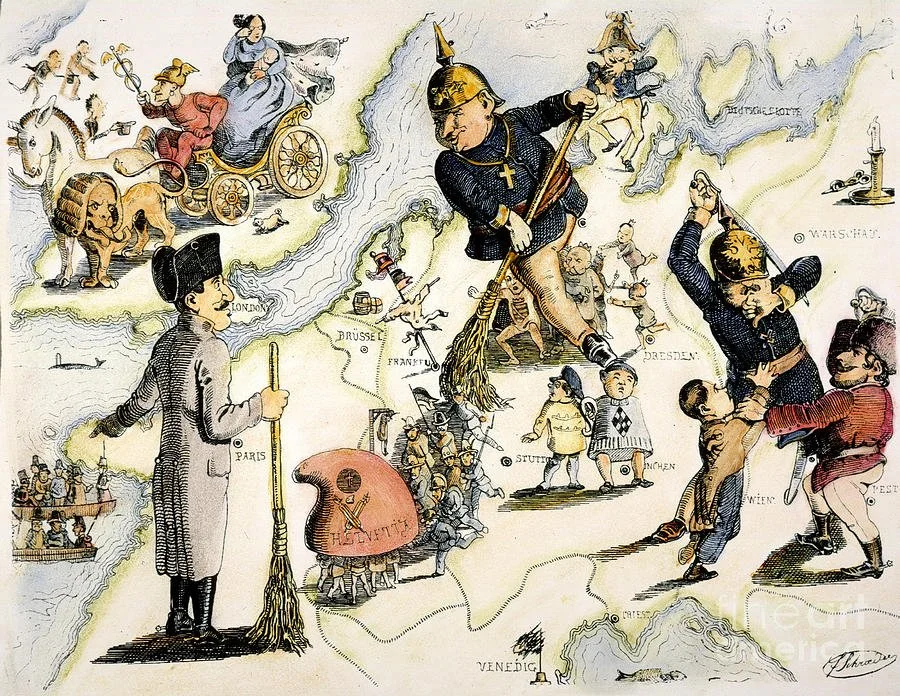
A German political cartoonist’s critique of the monarchs’ responses to the revolutions.
Conservatives vs. Liberals
At the heart of the Revolutions of 1848 were two powerful groups with very different beliefs: conservatives and liberals.
Conservatives believed in keeping things the same. They supported kings, churches, and traditional authority. They feared that too much change would lead to chaos, like during the French Revolution. Furthermore, they wanted strong governments and limited freedoms.
Liberals, on the other hand, wanted reform. They supported constitutions, voting rights, and individual freedoms. Many believed in the right of nations to rule themselves instead of being controlled by empires. They were often middle-class people, lawyers, teachers, and merchants, who wanted governments to represent citizens, not just nobles.
The revolutions of 1848 were part of a larger struggle between these two worldviews. Although conservatives regained control afterward, liberal ideas continued to spread, laying the foundation for the democratic governments we know today.